Vergleich · 5 wesentliche Unterschiede
Duquesne Club vs The 'Quin House
Dieser Vergleich wurde auf Anfrage aus den Datensätzen generiert. Er enthält kein redaktionelles Urteil und ist nicht indexiert. Die veröffentlichten Vergleiche sind aufgeführt auf der Vergleichsseite.
Jede Spalte für sich gibt Auskunft über eine Organisation, jede Zeile im Vergleich zeigt den Unterschied. Ein bronzefarbenes Zeichen am linken Rand einer Zelle bedeutet, dass sich die Organisationen in dieser Zeile unterscheiden. Ein Strich oder „nicht veröffentlicht" bedeutet, dass die Organisation die Angabe nicht offenlegt; es handelt sich nicht um einen Nullwert.
 Verifiziert September 2026
 Duquesne Club
The club says what was once "a fraternity of prominent industrialists has evolved into a social and business retreat for the region's most interesting thinkers and innovative…
The 'Quin House
The club describes itself as "a club for the interesting and interested" and "a diverse community of leaders, creators, innovators, and influencers", and says that no matter one's…
Was die Quellen besagen
- Minimum age: Duquesne Club: No published minimum age; The 'Quin House: The club is for adults aged 21 and over.
- Geographic restriction: Duquesne Club: No published geographic restriction; The 'Quin House: Non-Resident membership requires working and living outside a 50-mile radius of Boston.
- Annual dues: Duquesne Club: Not publicly disclosed; The 'Quin House: The club states that membership is renewed on a yearly basis but does not publish dues; discounted two-year pricing exists for the Arts, Civic, Non-Profit category and a lower-priced Non-Resident category exists, neither of them priced publicly.
Nebeneinander
| Duquesne Club | The 'Quin House | |
|---|---|---|
| Profil | ||
| Typ | Private club | Private club |
| Gegründet | 1873 (The club's history page dates its founding to 1873 as a "voluntary association" first led by President John H. Ricketson.) | 2021 (The club states that The 'Quin House opened on 7 July 2021. Its building and lineage go back to the Algonquin Club, founded in 1886, whose clubhouse McKim, Mead & White completed at 217 Commonwealth Avenue in 1888.) |
| Hauptsitz | Pittsburgh, United States | Boston, United States |
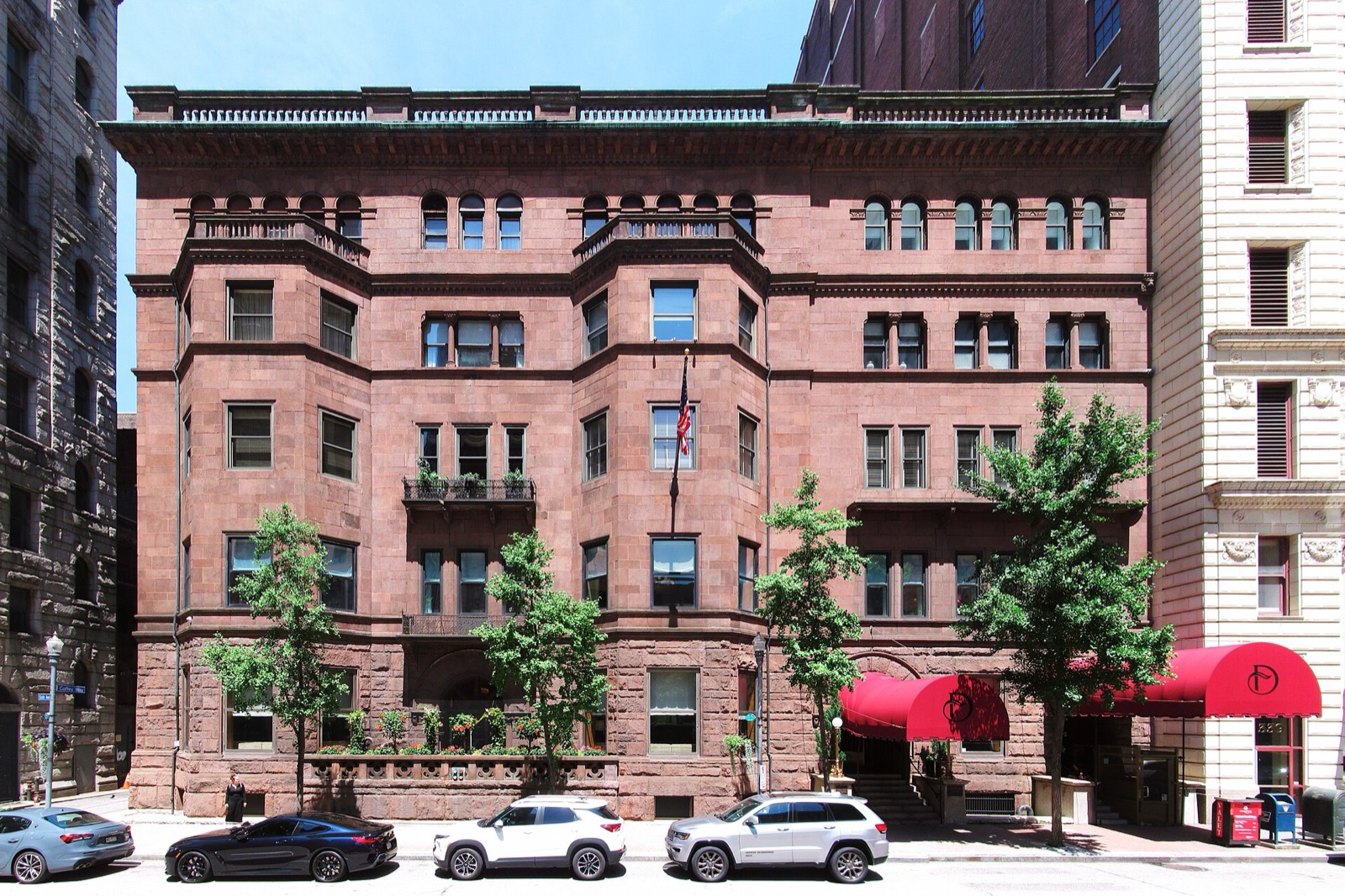
| Geographic footprint | Single clubhouse at 325 Sixth Avenue in downtown Pittsburgh | Single 56,000 square foot clubhouse at 217 Commonwealth Avenue in Back Bay, Boston |
| Mitglieder | Not publicly disclosed by the club. Wikipedia's article gives approximately 2,700 men and women, a figure it dates to 2007; that has not been independently verified. | Not publicly disclosed |
| Kapitel | Single clubhouse; no chapters | Single clubhouse; no chapters |
| Primary audience | The club says what was once "a fraternity of prominent industrialists has evolved into a social and business retreat for the region's most interesting thinkers and innovative leaders in business, industry, finance, politics, education, philanthropy, law, medicine and the arts". | The club describes itself as "a club for the interesting and interested" and "a diverse community of leaders, creators, innovators, and influencers", and says that no matter one's age, profession or creed, "if you're looking for your people, join us". |
| Typisches Mitglied | Not publicly disclosed in numbers. The club describes members as regional leaders across business, finance, law, medicine, education, politics, philanthropy and the arts. | Not publicly disclosed in numbers. The club characterises its membership as leaders, creators, innovators and rising stars, and reserves a discounted category for people working in the arts, civic and non-profit sectors who would otherwise be unable to join. |
| Qualification | ||
| Mindestalter | No published minimum age | The club is for adults aged 21 and overChildren aged 16 and over may accompany parents as guests for meals and may stay overnight when a parent is also staying; children over 6 are allowed during specific family programming and weekend brunch in Cafe Q; members' children under 21 may only be on the premises with a parentverified September 2026 · Quelle ↗ |
| Geografische Einschränkung | No published geographic restriction | Non-Resident membership requires working and living outside a 50-mile radius of BostonThe club describes it as an affordable option for those who need to travelverified September 2026 · Quelle ↗ |
| Invitation required | Yes | Yes |
| Sponsor required | Not documented | Yes |
| Application process | No application process is published. The club's membership pages describe benefits rather than admission, and there is no application form or membership contact on the public site. | Membership is currently by invitation through a referral from a current member. Prospective members without a referral, and applicants for the Arts, Civic, Non-Profit category, are directed to contact the membership team by email. The club encourages applicants to include a spouse or partner on the information submission. |
| Selectivity | Not publicly disclosed | Not publicly disclosed. The club publishes no acceptance rate, member cap or waiting-list information, though it states that the Arts, Civic, Non-Profit category is limited to a select number of applicants. |
| Kosten | ||
| Jahresbeiträge | Not publicly disclosedverified September 2026 · Quelle ↗ | The club states that membership is renewed on a yearly basis but does not publish dues; discounted two-year pricing exists for the Arts, Civic, Non-Profit category and a lower-priced Non-Resident category exists, neither of them priced publiclyverified September 2026 · Quelle ↗ |
| Aufnahmegebühr | Not publicly disclosedverified September 2026 · Quelle ↗ | The club confirms that membership carries a one-time initiation fee but does not publish the amount; no reliable published figure was locatedverified September 2026 · Quelle ↗ |
| Membership term | Not documented | Annual renewal, with a one-time initiation fee; Arts, Civic, Non-Profit pricing runs on a renewable two-year basis |
| Struktur | ||
| Meeting frequency | No published meeting programme beyond a member events calendar; the six special-interest societies run their own tastings, dinners, classes, tours and outings | Ongoing programming including speakers, book talks, culinary events, wellness activities and social events |
| Peer forums | Six member-run special-interest societies: Wine (about 300 members), Art, Rod & Gun, Literary, Culinary and Beer | Not documented |
| Confidentiality | Not publicly disclosed | Not publicly disclosed. The club publishes a set of club rules as a separate document. |
| Time commitment | Not documented | Not documented |
| Organized as | Clubhouse premises, Event-focused | Clubhouse premises, Event-focused |
| Vertrauliche Peer-Foren | No | No |
| Lokale Kapitel | No | No |
| Virtuelle Mitgliedschaft | No | No |
| Online-Community | No | No |
| Mitgliederverzeichnis | Not documented | Not documented |
| Veranstaltungen | Yes | Yes |
| Programmierung | ||
| Bildungsprogramme | Partial | Yes |
| Führungskräfteentwicklung | No | No |
| Retreats | No | No |
| Reisen | Yes | Yes |
| Familienprogramme | Yes | Partial |
| Programme für Ehe- und Lebenspartner | Not documented | Yes |
| Next-Generation-Programm | Not documented | Not documented |
| Investment-Diskussionen | No | No |
| Investment-Möglichkeiten | No | No |
| Philanthropische Komponente | Yes | Yes |
| Schwerpunkt Vernetzung | High | High |
| Sozialer Schwerpunkt | High | High |
Weiter
Quellen
Entnommen aus den auf jeder Seite aufgeführten Quellen: Duquesne Club · The 'Quin House