Leadership network · Young leaders · Professional leadership
Forum of Young Global Leaders
Leaders under 40 drawn from business, government, civil society, academia, media, the arts and social enterprise
A profile page holds what the organization publishes and what named sources report: who it admits, what it costs, how it is structured, where it operates, and how it has changed. Every figure carries the date it was checked. A dash means the organization does not publish that fact.
Founding — Created by World Economic Forum founder Klaus Schwab in 2004; the community marked its 20th anniversary in 2024. The YGL Foundation describes itself as a private foundation based in Switzerland but does not publish a city on its public pages.
The Forum of Young Global Leaders is a leadership community convened by a Swiss private foundation established by the World Economic Forum. Each year it selects roughly 100 to 120 people under the age of 40 from business, public office, science, civil society, media and the arts, and enrols them in a structured development programme. The current programme runs for three years and combines academic modules (including executive education at Harvard Kennedy School), thematic gatherings, and participation in World Economic Forum activities such as the Annual Meeting in Davos. On completing the programme, members move into an alumni community that continues to meet. Membership is not open to application: candidates are nominated by Forum members and partners, screened against published criteria, and selected through a process that has historically involved an external executive search firm and a selection committee. The community reports more than 1,400 members and alumni from over 120 countries. The foundation also convenes the World Economic Forum's Global Future Council on Leadership.
How it works
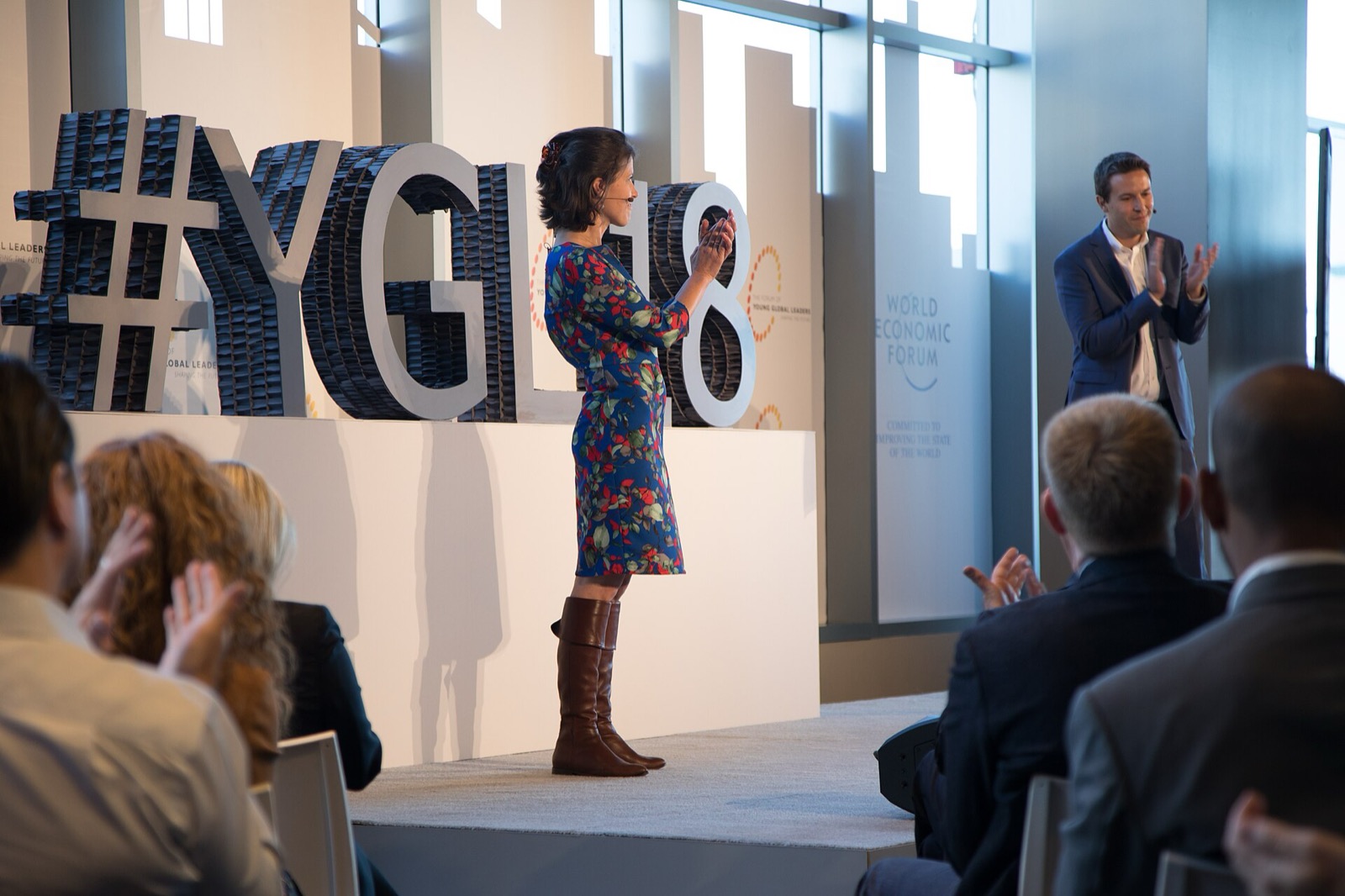
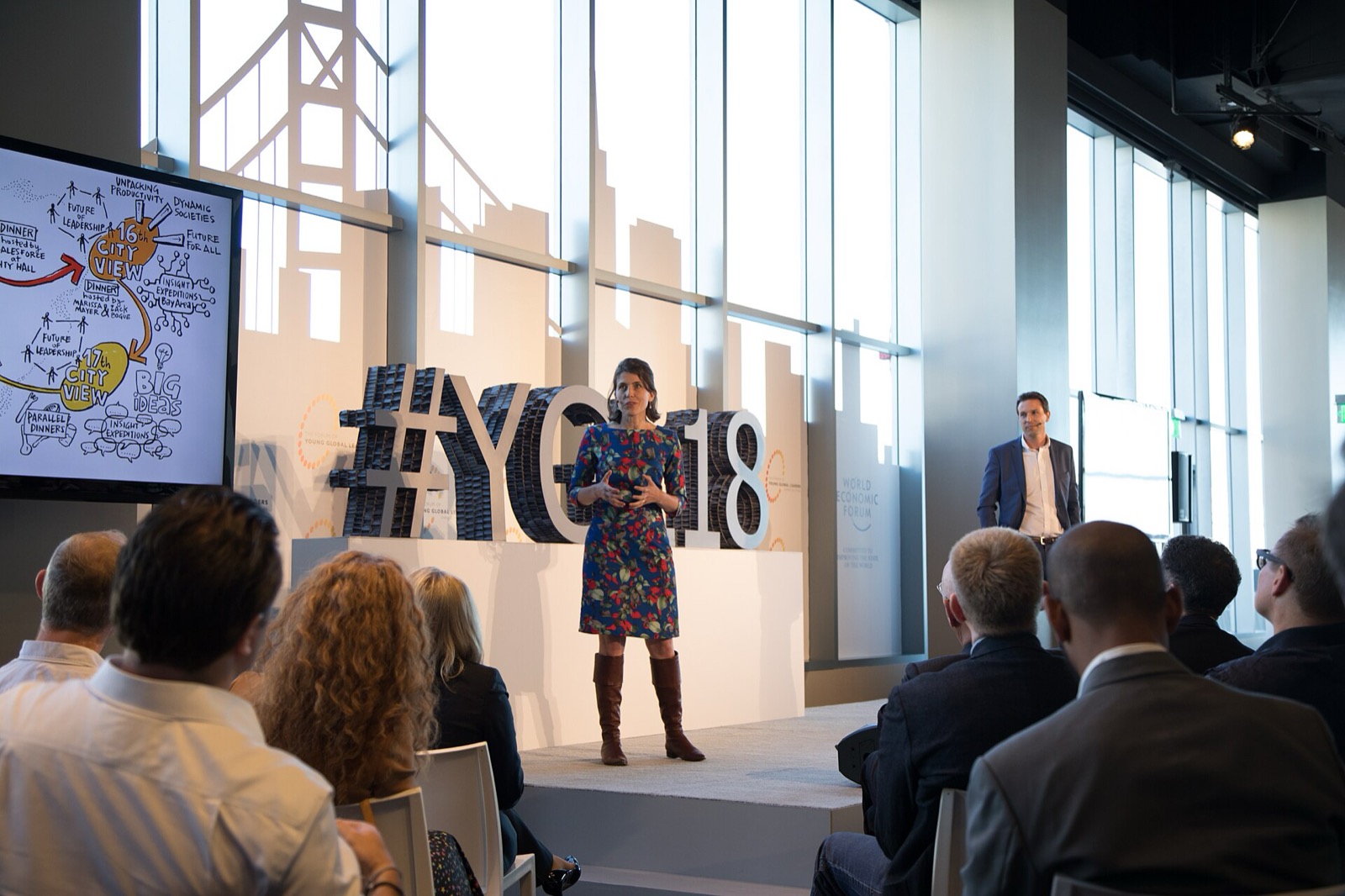
New members enter as an annual class and complete a three-year development programme of academic modules, thematic gatherings and contributions to World Economic Forum initiatives. Members attend Forum convenings, including Davos, and periodic YGL-only summits such as the 20th anniversary gathering in Singapore in 2024. After the programme they join the alumni community and retain access to community events. There are no local chapters; cohesion comes from classes, regional groupings and Forum events.
Typical member
Members are selected in annual classes of roughly 100-120 people under the age of 40 and include ministers, heads of state, chief executives, founders, scientists, journalists and artists. The Class of 2026 comprised 118 leaders from 55 countries.
Membership requirements
Requirements in detail, with history →Requirements are the tests the organization itself publishes — an age ceiling, a company-revenue floor, a net-worth minimum, a role. Where a figure straddles a range, the organization's own assessment decides. Local chapters can apply stricter tests than the published standard.
| Criterion | Published requirement | Provenance |
|---|---|---|
| Maximum age at joining | Under 40 at the time of nomination | Verified September 2026High confidenceSource ↗ |
| Invitation | Nomination by a World Economic Forum member or partner; self-nomination not accepted | Verified September 2026High confidenceSource ↗ |
| Minimum tenure in role | Typically 5 to 15 years of outstanding professional experience | Verified September 2026Medium confidenceSource ↗ |
| Role or title | Business-sector candidates must run a qualifying company or division as President, Chairman, CEO, Managing Director, Managing Partner, Publisher or equivalent | Verified September 2026Medium confidenceSource ↗ |
| Other criterion | Demonstrated commitment to serving society beyond professional duties, an impeccable public record and good standing | Verified September 2026High confidenceSource ↗ |
Published criteria as verified on the dates shown. Final eligibility and admission decisions belong entirely to Forum of Young Global Leaders. See how you compare against these criteria →
Initiation fees are paid once on joining; dues recur. Chapter dues, retreats, travel and events are usually additional and are listed separately when the organization discloses them. Figures are as published or reported on the date shown — not quotations.
| Cost | First year | Three years | Provenance |
|---|---|---|---|
| Annual dues | Not publicly disclosed | ||
| Programme fee | Not publicly disclosed | ||
Structure and programming
Independent context
The YGL programme is a recognition-and-development network rather than a peer-advisory or business group: nobody applies, and the value is proximity to the World Economic Forum's convening system rather than confidential problem-solving with peers. Two details are worth noting. First, the programme length has changed: older Forum material describes a five-year commitment, while the current site describes a three-year programme, so descriptions found elsewhere may be out of date. Second, the published nomination criteria are qualitative and the substantive filters (who may nominate, how the selection committee decides) are not disclosed. The Forum does not publish member dues or any fee schedule, and it does not publish an acceptance rate beyond saying that around 100 places are filled from thousands of candidates. The community has attracted sustained outside commentary about influence and elite networks; that commentary is not evidence about how selection actually works.
Editorial analysis by Peer Group Guide editors. It is separated from the record above and follows the editorial policy.
Similar organizations
Alternatives, grouped by need →Appears in: Organizations for chief executives under 45
History and changes
Site-wide change log →- milestoneKlaus Schwab, founder of the World Economic Forum, creates the Forum of Young Global Leaders ↗
- milestoneNearly 500 Young Global Leaders convene in Singapore for the community's 20th anniversary summit ↗
- milestone65 members attend Harvard Kennedy School executive education (Public Policy in the 21st Century); 70 attend the Forum's Annual Meeting in Davos ↗
- milestoneClass of 2026 announced: 118 leaders under 40 from 55 countries ↗
Milestones as published by the organization or reported by a named source. “Record” entries are changes to this site’s own record of the organization, kept in the public change log rather than overwritten.
Take the next step
Check how you compare
Run the published criteria against a profile given in ranges. Nothing is stored.
Open the qualification toolRequest membership information
We pass on only what you agree to share, and only where the organization participates. You see exactly what is sent before you send it.
Request informationFollow this organization
One email when its requirements or fees change.
Sources
- Home — The Forum of Young Global Leaders, Forum of Young Global Leaders Foundation. Accessed 6 September 2026.tier 1
- About — Young Global Leaders, Forum of Young Global Leaders Foundation. Accessed 6 September 2026.tier 1
- Two decades of impact: The Forum for Young Global Leaders turns 20 (read via search result snippet), World Economic Forum, January 2024. Accessed 6 September 2026.tier 1
- Entrepreneurs, Public Leaders and Innovators Join the Young Global Leaders Class of 2026 (read via search result snippet), World Economic Forum, April 2026. Accessed 6 September 2026.tier 1
- Nominations — Young Global Leaders, Forum of Young Global Leaders Foundation. Accessed 6 September 2026.tier 2
- YGL Nomination Criteria (PDF), World Economic Forum. Accessed 6 September 2026.tier 2
Source tiers follow the published hierarchy: 1 official site · 2 official membership materials · 3 application documents · 4 annual reports · 5 government filings · 6 reliable business publications · 7 credible interviews · 8 other reputable secondary sources. Sources and data policy.
Is something wrong or out of date?
Represent Forum of Young Global Leaders? Verified representatives can submit corrections to fees, criteria, chapters and contact details, and add approved material. Submissions are reviewed by an editor and shown as organization-supplied; they never overwrite independent research.