Private club · Members' clubs · Business clubs
Harvard Club of Boston
The club states its mission is to be "the social, intellectual, and athletic hub for Harvard alumni and our affiliated community in the Greater Boston area", and its published eligibility extends to alumni of Harvard, MIT, Yale and the Fletcher School at Tufts, faculty and students of Harvard and MIT, medical residents and fellows at Harvard-affiliated hospitals, and the direct relatives of member
A profile page holds what the organization publishes and what named sources report: who it admits, what it costs, how it is structured, where it operates, and how it has changed. Every figure carries the date it was checked. A dash means the organization does not publish that fact.
Founding — The club's timeline records that 22 alumni men started the Harvard Club of Boston in 1908 with annual dues set at $5.
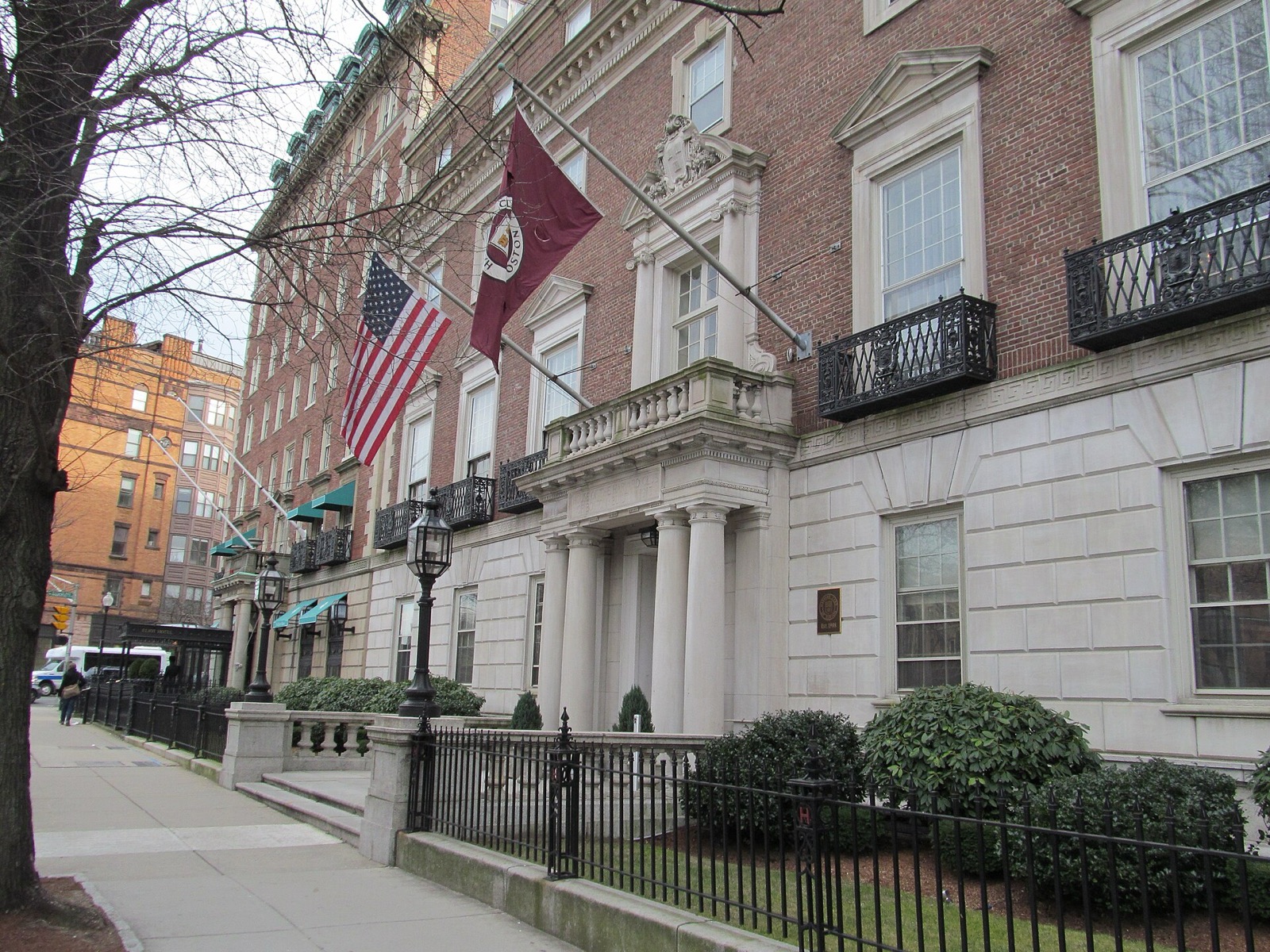
The Harvard Club of Boston is a private club founded in 1908 by 22 Harvard alumni and housed since 1913 in a Back Bay clubhouse at 374 Commonwealth Avenue. Unlike most clubs of its type it publishes both its eligibility rules and its full fee schedule. Membership is open to alumni of Harvard, MIT, Yale and the Fletcher School at Tufts; full-time Harvard and MIT faculty; undergraduate and graduate students of Harvard and MIT and their families; residents, fellows and faculty-appointed physicians at Harvard-affiliated hospitals; and the children, grandchildren, parents and grandparents of current affiliated members. A separate Commonwealth category, capped at 50 places a year, admits friends and family of members who would not otherwise qualify and requires a member sponsor. Harvard's Class of 2026 receives a complimentary membership through 31 August 2027. Fees vary by age band and by whether the member lives within 15 miles, 16 to 50 miles, 51 or more miles, or outside the United States. The clubhouse holds three dining venues, a member commons with co-working space and phone booths, a fitness centre, three storeys of squash courts and a pickleball court, and 25 overnight rooms.
How it works
Members apply online; the club verifies their university affiliation directly, confirms fees and activates the membership, a process it says takes 10 to 15 business days. Dues may be paid monthly, quarterly, semi-annually or annually, and a facilities renewal assessment covering capital repairs is built into the published cost. Spouses or domestic partners are included at no extra dues cost and receive their own member number and full privileges; children under 21 can be included. The club runs more than 250 member events a year, member-led shared interest groups, a golf society with access to regional country clubs, and reciprocal access to more than 170 private clubs worldwide.
Typical member
Alumni, students, faculty, parents and affiliates of Harvard and MIT, plus Yale and Tufts Fletcher School alumni, together with a limited number of Commonwealth members admitted as friends and family of existing members. Fees are banded by age and by distance from the clubhouse.
Membership requirements
Requirements in detail, with history →Requirements are the tests the organization itself publishes — an age ceiling, a company-revenue floor, a net-worth minimum, a role. Where a figure straddles a range, the organization's own assessment decides. Local chapters can apply stricter tests than the published standard.
| Criterion | Published requirement | Provenance |
|---|---|---|
| Other criterion | Eligibility runs through university affiliation: alumni of Harvard, MIT, Yale and the Fletcher School at Tufts; full-time faculty of Harvard and MIT; undergraduate and graduate students of Harvard and MIT and their families; residents and fellows at Harvard-affiliated hospitals; physicians with facu | Verified September 2026High confidenceSource ↗ |
| Sponsorship | Commonwealth membership is open to applicants not otherwise eligible: 50 places are reserved each year for friends and family of current members, and a member sponsor is required | Verified September 2026High confidenceSource ↗ |
| Other criterion | Harvard University Class of 2026 graduates are eligible for a complimentary membership running through 31 August 2027 | Verified September 2026High confidenceSource ↗ |
| Geographic restriction | Fees are set by the ZIP codes where an applicant lives and works: Resident 1 within 15 miles, Resident 2 within 16 to 50 miles, Nonresident 51 or more miles within the United States, and International outside the United States | Verified September 2026High confidenceSource ↗ |
| Other criterion | Business casual is the clubhouse standard; the club's definition includes denim and jackets and ties are not required | Verified September 2026High confidenceSource ↗ |
Published criteria as verified on the dates shown. Final eligibility and admission decisions belong entirely to Harvard Club of Boston. See how you compare against these criteria →
Initiation fees are paid once on joining; dues recur. Chapter dues, retreats, travel and events are usually additional and are listed separately when the organization discloses them. Figures are as published or reported on the date shown — not quotations.
| Cost | First year | Three years | Provenance | |
|---|---|---|---|---|
| Monthly duesa month, counted ×12 | $2,916 | $8,748 | Verified September 2026High confidenceSource ↗ | |
| Initiation feeonce | $2,316 | $2,316 | Verified September 2026High confidenceSource ↗ | |
| Other cost | $100 quarter per quarter, varies, not added | Verified September 2026High confidenceSource ↗ | ||
| Estimated total, disclosed figures only | $5,232 | $11,064 | Not counted: Other cost (per quarter, varies, not added). | |
Structure and programming
Independent context
This is the most legible club in the batch for anyone assessing cost against benefit. The published schedule prices membership by age and distance rather than by negotiation, so a 33-year-old living in Boston pays a $2,280 initiation fee and $250 a month, while a 45-year-old overseas alumnus pays $1,239 and $133. The Commonwealth category is the notable structural feature: 50 places a year, member sponsor required, for people with no university connection, which is an explicit and quantified side door that most alumni clubs do not publish. Two things to check before relying on older descriptions. The club's site now describes the Back Bay clubhouse as one of only two Harvard Club clubhouses in the world and lists no downtown location, although its own timeline records a Downtown Clubhouse established at One Federal Street in 1976 and renovated in 2003; the club does not state when that closed. And the culture is deliberately unstuffy for a club of this age: business casual including denim, no jackets or ties required, and laptops and phones welcome outside the restaurant.
Editorial analysis by Peer Group Guide editors. It is separated from the record above and follows the editorial policy.
Similar organizations
Alternatives, grouped by need →History and changes
Site-wide change log →- fee change22 alumni men started the Harvard Club of Boston with annual dues set at $5; Henry Lee Higginson served as first president ↗
- milestoneClub established $200 scholarship grants for local high school students attending Harvard ↗
- milestoneMembership grew to nearly 1,200 ↗
- milestoneBack Bay clubhouse opened; a room with bath cost $2 a night ↗
- milestoneEight squash courts built, beginning the club's association with squash and fitness ↗
- milestoneWomen were allowed into the club but only to dine in the women's Annex ↗
- milestoneWomen welcomed to full and active membership, the same year Harvard University became co-educational ↗
- milestoneDowntown Clubhouse established on the 38th floor of One Federal Street ↗
- milestoneDowntown Clubhouse underwent a $2.5m refurbishment ↗
- milestone$16m renovation of the Back Bay Clubhouse ↗
- milestoneKaren Van Winkle became the club's first female president, per Wikipedia ↗
- fee changeCurrent dues and initiation fee schedule took effect ↗
Milestones as published by the organization or reported by a named source. “Record” entries are changes to this site’s own record of the organization, kept in the public change log rather than overwritten.
Take the next step
Check how you compare
Run the published criteria against a profile given in ranges. Nothing is stored.
Open the qualification toolRequest membership information
We pass on only what you agree to share, and only where the organization participates. You see exactly what is sent before you send it.
Request information Apply on their site ↗Follow this organization
One email when its requirements or fees change.
Sources
- Harvard Club of Boston, Harvard Club of Boston. Accessed 6 September 2026.tier 1
- History of the Club - Harvard Club of Boston, Harvard Club of Boston. Accessed 6 September 2026.tier 1
- About Us - Harvard Club of Boston, Harvard Club of Boston. Accessed 6 September 2026.tier 1
- General Information - Harvard Club of Boston, Harvard Club of Boston. Accessed 6 September 2026.tier 1
- Reciprocal Clubs - Harvard Club of Boston, Harvard Club of Boston. Accessed 6 September 2026.tier 1
- Membership: Eligibility, Categories & Fees, Application Process - Harvard Club of Boston, Harvard Club of Boston. Accessed 6 September 2026.tier 2
- Harvard Club of Boston Annual Dues, Effective September 1, 2026, Harvard Club of Boston, September 2026. Accessed 6 September 2026.tier 2
- Membership - Harvard Club of Boston, Harvard Club of Boston. Accessed 6 September 2026.tier 2
- Become a Member - Harvard Club of Boston, Harvard Club of Boston. Accessed 6 September 2026.tier 3
- Harvard Club of Boston - Nonprofit Explorer, ProPublica (IRS Form 990 data). Accessed 6 September 2026.tier 5
- Harvard Club of Boston, Wikipedia. Accessed 6 September 2026.tier 8
Source tiers follow the published hierarchy: 1 official site · 2 official membership materials · 3 application documents · 4 annual reports · 5 government filings · 6 reliable business publications · 7 credible interviews · 8 other reputable secondary sources. Sources and data policy.
Is something wrong or out of date?
Represent Harvard Club of Boston? Verified representatives can submit corrections to fees, criteria, chapters and contact details, and add approved material. Submissions are reviewed by an editor and shown as organization-supplied; they never overwrite independent research.