Private club · Members' clubs · Business clubs
Cosmos Club
The club describes itself as "a private Washington, D.C. social club for individuals distinguished in science, literature, the arts, learned professions, or public service" and says that to become a member "an individual must demonstrate distinction in their prospective artistic, scientific, literary, public service, or professional career".
A profile page holds what the organization publishes and what named sources report: who it admits, what it costs, how it is structured, where it operates, and how it has changed. Every figure carries the date it was checked. A dash means the organization does not publish that fact.
Founding — The club states it has "provided a prestigious environment for intellectual fellowship since 1878"; it was organised by John Wesley Powell and a circle of Washington scientists after Clarence Dutton asked why Washington had no club like the Century.
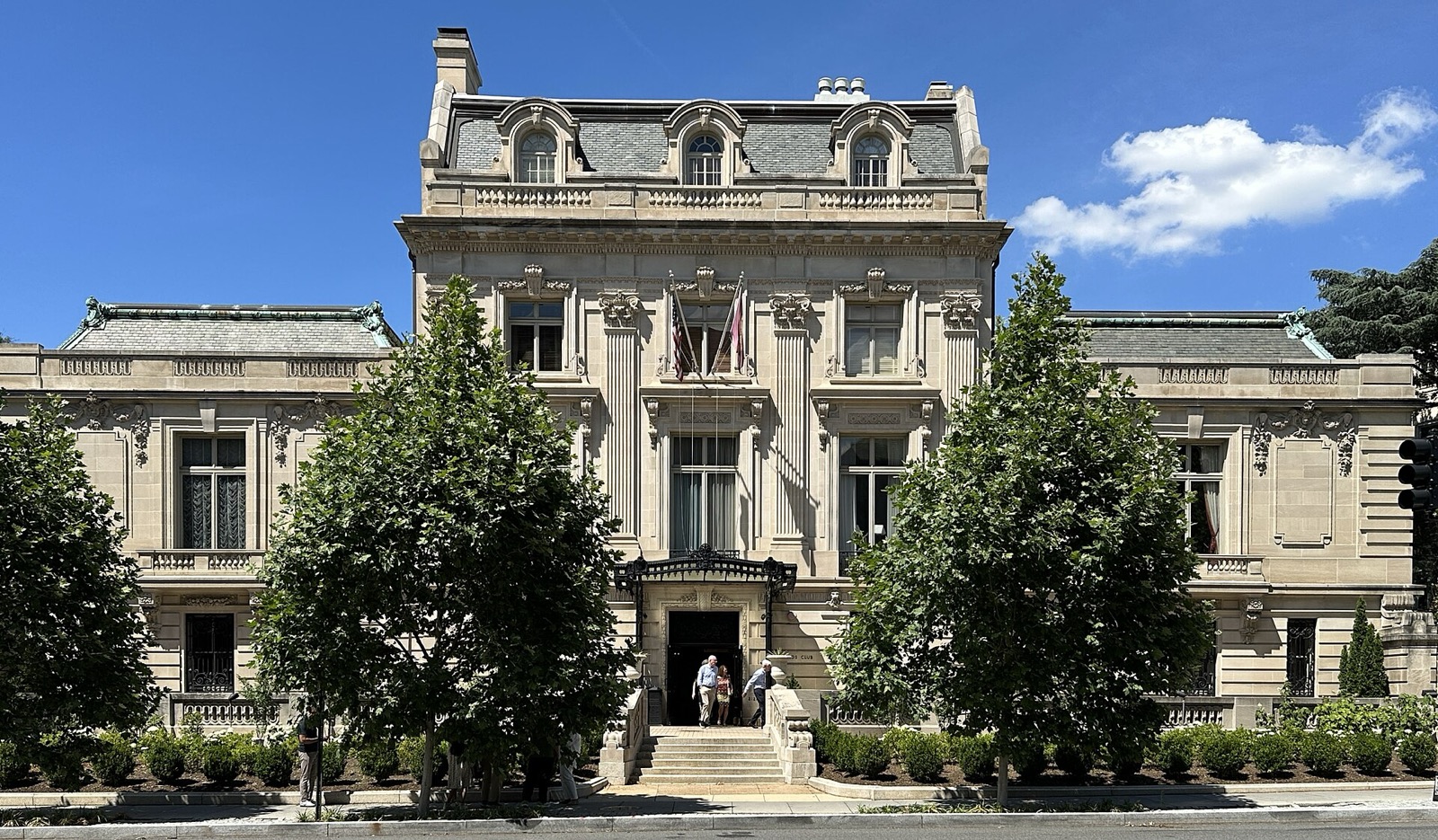
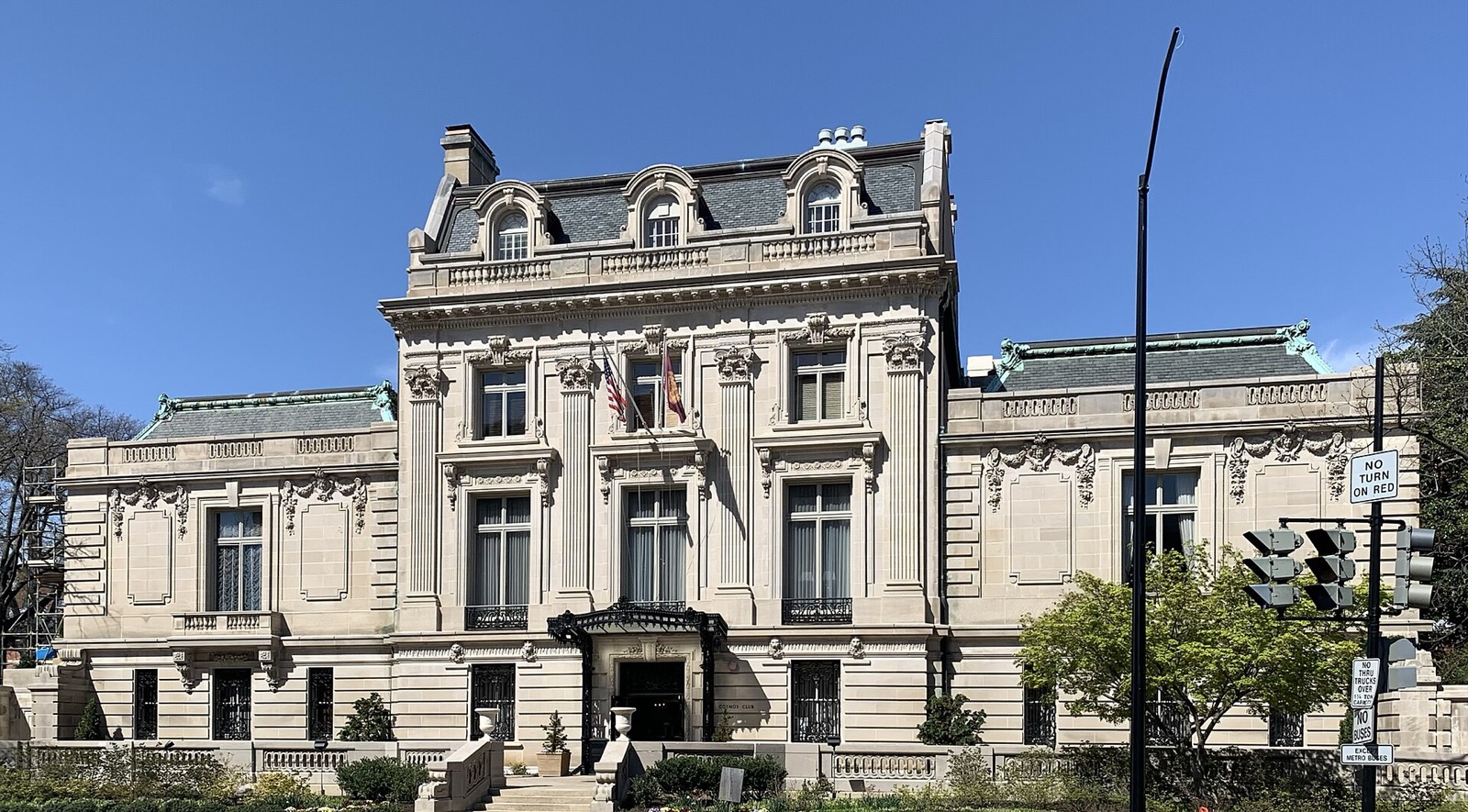
The Cosmos Club is a private club in Washington DC founded in 1878 by John Wesley Powell and a circle of scientists and explorers who wanted a Washington equivalent of New York's Century Association. Unlike most city clubs, its membership test is explicitly achievement-based: the club says a candidate must demonstrate distinction in an artistic, scientific, literary, public-service or professional career. It has occupied the Townsend House at 2121 Massachusetts Avenue NW, a Beaux-Arts mansion built by Carrere and Hastings, since 1952, together with the adjoining Hillyer House and an annex. Programming is intellectual as much as social: lectures across disciplines, concerts, literary conversations and study groups sit alongside brunches, wine tastings and dinner dances, and the club's library holds over ten thousand volumes, most of them available for loan. The club runs guest rooms, the Garden Dining Room and Garden Bar, and private rooms for events, and offers reciprocal privileges to members of other clubs. The public website carries no membership page, application form or fee schedule.
How it works
Members use one clubhouse in Dupont Circle for dining, lectures, concerts, study groups and social events, with guest rooms in the Mansion, the Hillyer House and the Annex. Reciprocal club members may book overnight rooms -- each stay includes a full breakfast for two -- and use the fitness centre, which is closed to one-day guest-pass holders; the clubhouse is open to reciprocal members daily from 7am to 11pm except on listed holidays. The club is named on the reciprocal lists of other city clubs, including the Duquesne Club in Pittsburgh.
Typical member
Members are people with a record of distinction in science, literature, the arts, a learned profession or public service. The club says its members have included three US presidents, two vice-presidents, 14 Supreme Court justices, 36 Nobel Prize winners, 61 Pulitzer Prize winners and 55 recipients of the Presidential Medal of Freedom.
Membership requirements
Requirements in detail, with history →Requirements are the tests the organization itself publishes — an age ceiling, a company-revenue floor, a net-worth minimum, a role. Where a figure straddles a range, the organization's own assessment decides. Local chapters can apply stricter tests than the published standard.
| Criterion | Published requirement | Provenance |
|---|---|---|
| Other criterion | Candidates must demonstrate distinction in an artistic, scientific, literary, public-service or professional career | Verified September 2026High confidenceSource ↗ |
| Other criterion | Members, families and guests must observe the club's dress code, which requires a sport jacket for men in the clubhouse from 1 October to 30 April and ties in the Garden Dining Room at lunch, dinner and Sunday brunch | Verified September 2026High confidenceSource ↗ |
Published criteria as verified on the dates shown. Final eligibility and admission decisions belong entirely to Cosmos Club. See how you compare against these criteria →
Initiation fees are paid once on joining; dues recur. Chapter dues, retreats, travel and events are usually additional and are listed separately when the organization discloses them. Figures are as published or reported on the date shown — not quotations.
| Cost | First year | Three years | Provenance |
|---|---|---|---|
| Annual dues | The club publishes no dues figure. Wikipedia reports annual dues of approximately $2,000 as of 2015; not independently verified and likely out of date | Source ↗ | |
| Initiation fee | Not publicly disclosed | Source ↗ | |
Structure and programming
Independent context
The Cosmos Club is the clearest American example of a club that selects on accomplishment rather than wealth or trade, and it says so plainly on its own site, which distinguishes it from nearly every other club in this batch. What it does not publish is how a candidate is proposed, who decides, what it costs or how many members there are: there is no membership page at all, so the criterion is public but the process is not. Wikipedia's figures -- about 3,089 members in 2017 and roughly $2,000 in annual dues around 2015 -- are the only numbers in circulation and are recorded here at low confidence. The club's dress code is among the strictest still enforced in Washington, with jackets required in the clubhouse from October to April and ties in the Garden Dining Room at lunch, dinner and Sunday brunch, and phone use is confined to designated spaces.
Editorial analysis by Peer Group Guide editors. It is separated from the record above and follows the editorial policy.
Similar organizations
Alternatives, grouped by need →History and changes
Site-wide change log →- milestoneClub founded by John Wesley Powell and a circle of Washington scientists and explorers after Clarence Dutton asked why Washington had no club like the Century ↗
- milestoneClub moved into the Townsend House at 2121 Massachusetts Avenue NW, a Beaux-Arts mansion built 1898-1900 by Carrere and Hastings, per Wikipedia ↗
- milestoneClub refused admission to the Black journalist Carl T. Rowan; Edward R. Murrow and John F. Kennedy withdrew their applications in protest, per Wikipedia ↗
- milestoneHistorian John Hope Franklin admitted as the club's first Black member, per Wikipedia ↗
- milestoneMembers voted 757-14 to admit women; the first female members were admitted in October 1988, per Wikipedia ↗
Milestones as published by the organization or reported by a named source. “Record” entries are changes to this site’s own record of the organization, kept in the public change log rather than overwritten.
Take the next step
Check how you compare
Run the published criteria against a profile given in ranges. Nothing is stored.
Open the qualification toolRequest membership information
We pass on only what you agree to share, and only where the organization participates. You see exactly what is sent before you send it.
Request informationFollow this organization
One email when its requirements or fees change.
Sources
- About The Club - Cosmos Club, Cosmos Club. Accessed 6 September 2026.tier 1
- History of the Club - Cosmos Club, Cosmos Club. Accessed 6 September 2026.tier 1
- Reciprocal Club Privileges - Cosmos Club, Cosmos Club. Accessed 6 September 2026.tier 1
- Reciprocal Clubs - Duquesne Club, Duquesne Club. Accessed 6 September 2026.tier 1
- Dress Code - Cosmos Club, Cosmos Club. Accessed 6 September 2026.tier 2
- Cosmos Club - Nonprofit Explorer, ProPublica (IRS Form 990 data). Accessed 6 September 2026.tier 5
- Cosmos Club, Wikipedia. Accessed 6 September 2026.tier 8
- Wayback Machine captures of cosmosclub.org (1 September 2026 and 1 February 2026), Internet Archive / Cosmos Club. Accessed 6 September 2026.tier 8
Source tiers follow the published hierarchy: 1 official site · 2 official membership materials · 3 application documents · 4 annual reports · 5 government filings · 6 reliable business publications · 7 credible interviews · 8 other reputable secondary sources. Sources and data policy.
Is something wrong or out of date?
Represent Cosmos Club? Verified representatives can submit corrections to fees, criteria, chapters and contact details, and add approved material. Submissions are reviewed by an editor and shown as organization-supplied; they never overwrite independent research.